


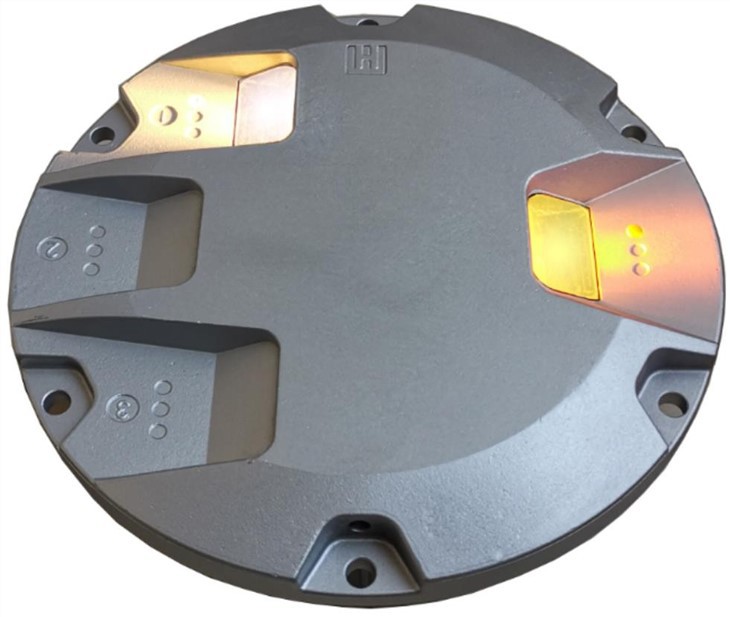

Runway edge lights

The runway edge light is an aviation signal lamp, including a transparent lampshade and a base, a base plate and a control circuit board are arranged in the base, and a plurality of LED light source bodies are arranged on the base plate, and the characteristic is that each LED light source body is equipped with There is a convex light distribution lens, and an umbrella-shaped lampshade cover is installed on the top of the transparent lampshade. The upper end of the transparent lampshade is connected to a conical reflector with a cone point downward. The center of the umbrella-shaped lampshade cover directly above the corresponding hole is a circular light-transmitting window. The LED light source body is a full primary color or a single primary color LED light source body; the light of the runway edge light is generated by the light source body through the cone The reflector emits a transparent lampshade after reflection, which has high luminous efficiency, low power consumption, good uniformity and easy installation, and is practical. China Airport Runway Threshold Light,runway middleline light manufacturers, Customized Runway threshold end light,China Airport Runway Centerline Light,China Airport Runway Threshold Wing-bar,China Airport Runway Threshold End Light, Airport Runway Threshold Wing-bar suppliers.
Definition
The lighting system consists of multiple sets of paired lights, in which the lights of the visual approach slope indication system are arranged symmetrically on both sides of the runway, and the precision progress course indicators are arranged on the left side of the runway. Both are used to guide the aircraft to maintain a normal glide path during the approach.
Specific instructions
A) When the aircraft is above the nominal glide path, the pilot of the aircraft sees all lights as white
B) When the aircraft is on the nominal glide path, see the leeward light is white and the upwind light is red
C) When it is below the nominal glide path, see all lights are red
Approach light category
The approach lighting system has different structural components according to the operating category of the runway. Specifically, it can be divided into simple approach lighting system, category I precision approach lighting system and category II precision approach lighting system.
Classification and Function
Runway lights
1. Run to the entrance light
(1). Runway entrance lights: The runway entrance lights are green and unidirectional in the direction of approach to the runway. The runway with runway edge lights must be equipped with runway entrance lights. If it is an instrument runway or a non-precision approach runway, the runway entrance lights shall have at least 6 lamps; if it is a precision approach runway, the runway entrance lights shall be arranged equidistantly along the runway entrance between the runway edge lights at intervals not greater than 3m.
(2). Runway threshold identification lights: When it is necessary to use the runway threshold more clearly or it is not practical to install other approach lights, set the runway threshold identification lights at the entrance of the non-precision approach runway. The runway threshold identification lights are symmetrically arranged on both sides of the runway center line, about 10m away from the runway edge lights, which are one-way white flashing lights facing the approach direction.
(3). Runway entrance wing bar lights: When it is necessary to make the entrance of the precision approach runway more obvious, or when the non-instrument runway and the non-precision approach runway do not have entrance lights due to the inward movement of the entrance, there should also be a runway at the entrance of the runway Entrance wing bar lights. The entrance wing bar lights are divided into two groups at the entrance of the runway symmetrically to the runway center line. Each wing bar light is composed of at least 5 lights, which are perpendicular to the runway edge light line and extend at least 10m. The lights are unidirectional green in the approach direction.
2. Runway edge lights
The runway used at night or the precision approach runway used at night is equipped with runway edge lights. The runway edge lights adopt light and easy-to-break lamps, which are constant white lights, but the light color of the runway edge lights within 600m from the end of the runway toward the middle of the runway is yellow (if the runway length is less than 1800m, the runway edge that emits yellow light The length occupied by the lights shall be one-third of the runway length). In addition, when the runway threshold is moved inward, the side lights from the end of the runway to the inwardly moved runway threshold are displayed in red in the direction of approach.
3. Runway end lights
The runway with runway edge lights must be equipped with runway end lights. The runway end lights are one-way constant luminous lights that emit red light in the direction of the runway. Normally the runway end lights are the same light as the runway threshold lights.
4. Runway Center Line Lights
A category II or category III precision approach runway must be equipped with runway center line lights. If a category I precision approach runway is intended to be used for aircraft takeoff when the runway visual range is less than about 400m, or for high-speed landing aircraft to land, or between runway edge lights When the width of the runway is greater than 50m, or it is intended to be used by aircraft with extremely high take-off speeds, runway centerline lights must also be provided.
The runway center line lights are arranged along the entire length of the runway center line with embedded lamps, and the deviation from the runway center line is allowed to be at most 0.6m. The distance between lights is generally 15m on category II or category III precision approach runways, and generally 30m on category I precision approach runways or other runways with centerline lights.
Usually, the runway center line lights are white from the entrance to the end of the runway within 900m, red and white from 900m to the end of the runway, red and white from 300m to the end of the runway, and red from 300m to the end of the runway . If the length of the runway is less than 1800m, it should be changed to red and white from the midpoint of the runway to 300m from the end of the runway
5. Grounding belt light
Touchdown zone lights must be provided on category II or category III precision approach runways. The touchdown zone lights shall consist of short bars of recessed unidirectional constant white lights, illuminated in the direction of approach. From the runway threshold to 900m after the runway threshold, they are symmetrically arranged on both sides of the runway center line at a distance of 60m (on the runway used when the RVR is equal to or greater than 300m) or 30m (on the runway used when the RVR is less than 300m).
7. Stop road lights
Equidistantly set along the entire length of the stopway on the extension line of the runway sideline lights, the distance between the lights is 40 meters to 60 meters, and the lights are red. In addition, the three lights set across the end of the stopway shall be perpendicular to the center line of the runway and no more than 3 meters away from the end line of the stopway.
Taxiway lighting
Taxiway lighting includes taxiway center line lights, taxiway edge lights, stop bar lights, intermediate holding position lights and runway guard lights, etc.
1. Taxiway center line lights
The taxiway center line light is generally set on the taxiway center line sign. The taxiway center line light is a constant luminous light that glows green. The size of its beam can only be seen from the aircraft on or near the taxiway. Centerline lights on exit taxiways are yellow and green towards the runway.
2. Taxiway edge lights
Taxiway edge lights are near the taxiway, the edge of the waiting apron or the apron or not more than 3m away from the edge, evenly distributed, with a longitudinal spacing of less than 60m, and are constant luminous lights that emit blue light.
3. Stop bar lights
Stop bars are located on taxiways where aircraft are required to hold for clearance and consist of a number of recessed lights that glow red toward aircraft approaching the stop bar. This light is controlled by Air Traffic Control (ATC).
4. Licensed horizontal light bar
The horizontal row of lights is set within 30 meters to 60 meters from the taxiway intersection and crosses the taxiway. There are at least 3 lamps, and the lights are fixed one-way yellow lights.
4. Intermediate waiting position light (observation passing light)
At taxiway intersections, unless stop bars have been provided, intermediate holding position lights are provided on taxiways where specific aircraft holding limits are required but do not require a stop or stop or release signal like stop bars. It consists of at least three unidirectional constant luminous lights that emit yellow light towards the intersection point, and are arranged symmetrically to the centerline of the taxiway.
5. Runway warning lights
According to the needs of operation, some runways are equipped with runway warning lights at the intersection of the runway and each taxiway. The runway warning lights consist of 4 vertical lights that emit one-way yellow light towards the aircraft approaching the runway from the taxiway. The lights are divided into two pairs symmetrically located on both sides of the taxiway. The two lights in each pair of runway warning lights flash alternately at a frequency of 30-60 flashes per minute.
English abbreviation meaning
CAT-I PALS -------- A kind of precision approach lighting system
HIAL ------------------ High Intensity Approach Lighting System
VASIS---------------- Visual Approach Slope Indication System
SALS---------------- Simple Approach Lighting System
PAPI------------------Precision Approach Course Indicator
LIZ-------------------- Heading lights
HIRL ------------------ High Intensity Runway Lights (Edge Lights)
MIRL------------------ Medium Intensity Runway Lights (Edge Lights)
LIRL------------------- Low Intensity Runway Lights (Edge Lights)
RCL------------------- Runway Center Line (marker)
RCLL------------------ Runway Center Line Lighting
RCLS ------------------ Runway Center Line Lighting System
Use general rules
(1) Aviation ground lights must be opened according to the following regulations:
A. Unless otherwise stipulated in the future or otherwise required by air traffic control, it should be open continuously when it is dark or when the center of the sun's sphere has dropped to 6 degrees below the horizon; in the above two cases, choose the time to use lights the longer;
B. At any other time, according to the weather conditions, for the safety of air traffic, when it is considered necessary to use lights
(2) There is no possibility of flight activities (including normal and emergency) over Nuo Airport, and it can be reopened one hour before the expected arrival of aircraft. Navigation lights can be turned off.
(3) At airports equipped with variable-intensity lights, an intensity adjustment table formulated according to visibility and external light conditions should be prepared to guide air traffic control personnel to adjust the lights to suit the prevailing meteorological conditions at that time. Aircraft pilots requested that further light intensity adjustments should be made whenever possible.
In aviation, safety is always the top priority. One of the essential elements for safe flight operations is the runway edge lights. These lights form a part of the airport's lighting system, helping pilots to maintain a safe distance from the runway boundary during takeoff and landing.
The traditional runway edge lights are usually placed on the ground alongside the tarmac. However, in some cases, such as airports located in areas prone to flooding or with uneven terrain, this may not be a suitable option. That's where the inset runway edge lights come into play.
Inset runway edge lights, also known as elevated lights, are mounted on the edges of runways instead of being placed on the ground. These lights rise above the runway surface, providing a clear visual reference for pilots even in wet or muddy conditions. This enhances the overall safety of flight operations and makes landing and takeoff more predictable and reliable.
China Airport Runway Edge Light, Customized Airport Runway Edge Light.

In addition to improving safety, elevated runway edge lights offer other advantages. They require less maintenance and are less susceptible to damage caused by uneven ground or heavy snowfall. They also provide improved visibility in low-light conditions, making the airport more efficient during periods of darkness or fog.
However, the installation of inset runway edge lights is not a simple process. It requires careful planning and design to ensure the lights are appropriately aligned and spaced to provide optimal visibility for pilots. The installation process is also labor-intensive, requiring heavy machinery and skilled workers.
Overall, the use of elevated runway edge lights is an essential element in the drive toward safer and more efficient air operations. They represent a significant investment for the airport, but the benefits in terms of safety and operational efficiency make them a worthwhile investment. As always, safety should remain the top priority, and the installation of these lights provides an essential step toward achieving that goal.
Hot Tags: inset runway edge light, China, suppliers, manufacturers, factory, customized, cheap, low price, Airport Runway Touchdown Zone Light, Airport Runway Threshold Light, solar airport runway lights, runway threshold light, taxiway stop light, 6 6A airport light