Incheon Airport has the highest number of international passengers in the world.
China Solar low B obstruction light,
Cheap Solar low B obstruction light,
Solar low B obstruction light price,
China Solar low A obstruction light,
According to Yonhap News Agency, Incheon International Airport in South Korea ranked first globally in international passenger traffic in the first half of this year, achieving this record for the first time since the airport opened in 2001.
Preliminary verified data released by the Incheon International Airport Corporation on the 13th showed that international passenger traffic increased by 6.3% year-on-year to 38.39 million from January to June this year. Based on statistics from the Airports Council International (ACI), Incheon Airport ranked first among 1,234 airports worldwide. London Heathrow Airport (37.79 million passengers) and Singapore Changi Airport (34.53 million passengers) followed.
The corporation's analysis suggests that the increase in passenger traffic at Incheon Airport was driven by the diversion of transit traffic from Middle Eastern airports such as Dubai to Europe due to the US-Iran conflict. Data shows that transit passenger traffic at Incheon Airport increased by 18.1% year-on-year in the first half of this year, reaching 4.24 million. Among them, passenger traffic to Europe surged by 63.2%, reaching 210,000. Furthermore, in the second quarter of this year (March-June), foreign passengers accounted for 44.4% of all passengers transported by Incheon Airport, a record high.
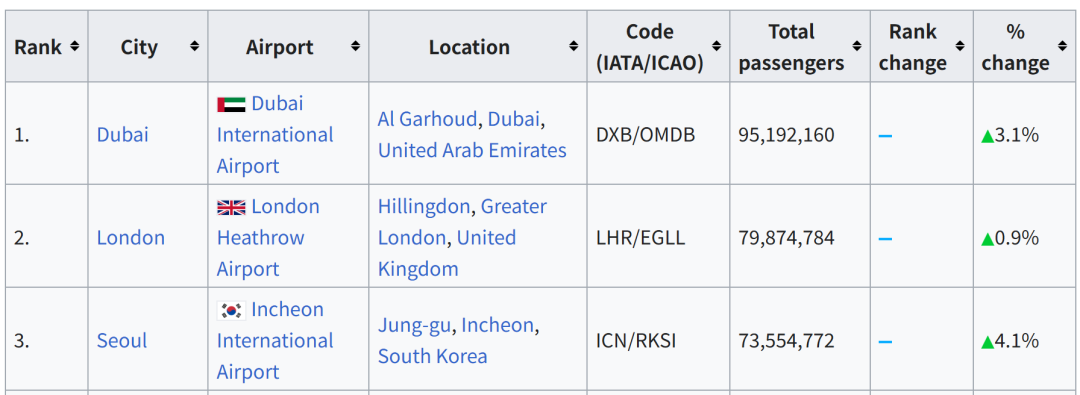
According to data released by the Airports Council International (ACI) for 2025, the top three airports globally in terms of international passenger throughput are: Dubai International Airport (ranked first with approximately 95.19 million passengers), London Heathrow Airport (ranked second with approximately 79.87 million passengers), and Incheon International Airport in South Korea (ranked third with approximately 73.55 million passengers). In addition, Incheon Airport is projected to rank 12th globally in total passenger throughput in 2025.