

A New Era for In-Flight Meals: AI Tools Reduce Waste and Optimize Menus
Elevated Obstacle Light,
low A obstruction light,
China Heliport windsock,
Cheap Heliport windsock,
Civil Aviation Resource Net, September 24, 2026: The International Air Transport Association (IATA) estimates that airlines generate nearly 4.7 billion pounds of food and beverage waste annually. Aviation catering professionals estimate that approximately 20% of the food and beverages loaded onto aircraft go uneaten.
Can AI technology help reduce this waste? Airlines and catering companies believe it can, while also improving the passenger dining experience.
At the recent International Flight Services Association (IFSA) Global Expo, attendees discussed a "black hole" in aviation catering data: actual consumption. Airlines know what food is loaded onto the plane but rarely have a true understanding of what is left over.
Rodney Duthie, President and COO of Paxia-a company specializing in aviation catering management software-stated that without this information, it is impossible to optimize food and beverage forecasting and procurement.
"In the past, airlines only tracked a sample of meals," Duthie said. "They distributed the meals but rarely conducted an actual reconciliation of consumption at the end of the flight."
He noted that increased workloads for cabin crew and restrictive clauses in labor contracts have historically hindered efforts to track meal consumption.
Furthermore, the tracking process involves more than just tallying whether passengers chose the chicken or the pasta. For airlines, it is equally crucial to understand which specific components of a meal are most frequently consumed and which remain largely untouched.
Duthie explained that such data can be analyzed alongside passenger survey results to help airlines fine-tune their menus and better align with passenger preferences.
Airlines Leading the Way
Carriers such as Lufthansa, Virgin Atlantic, and United Airlines have already pioneered the use of AI technology to track passenger meal consumption.
Lufthansa launched its "Tray Tracker" technology at Frankfurt Airport in 2024 and expanded the initiative to Munich Airport last year.
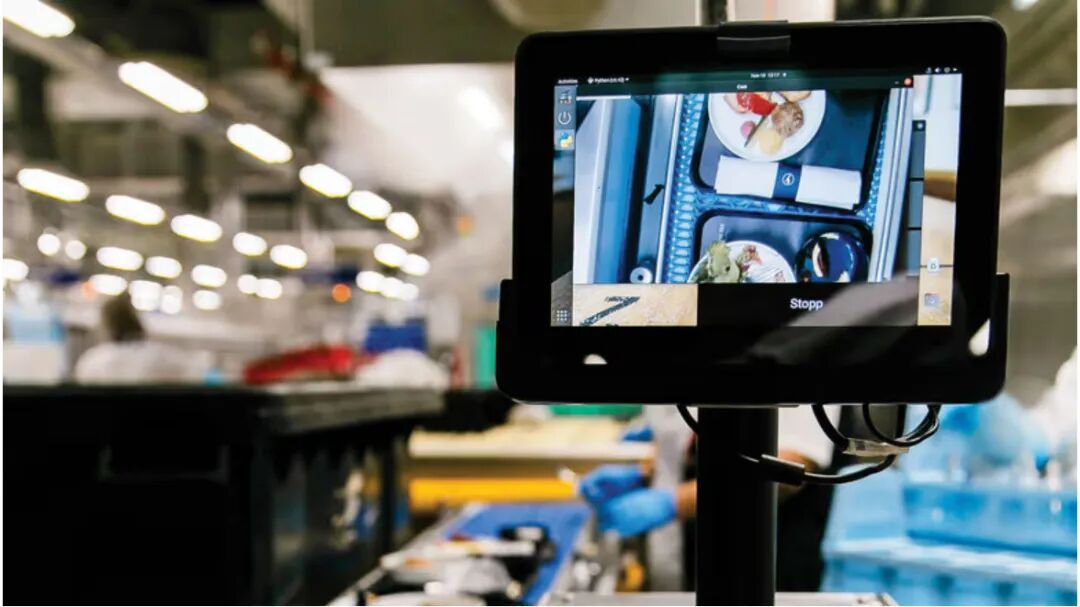
◇ Lufthansa utilizes an AI-powered tray-tracking system to monitor food consumption on its flights.
This solution scans returned meal trays on the dishwashing line, using AI to determine whether meals were partially eaten, fully consumed, or left untouched; the analysis also incorporates data on flight routes and cabin classes.
Lufthansa aims to use this data to optimize meal portions and menu selections. This initiative is designed not only to reduce waste but also to lower the aircraft's total weight, thereby cutting fuel consumption and carbon emissions.
Duti notes that while such tray-analysis methods offer practical value, they face challenges regarding data interference. Passengers and cabin crew sometimes mix different meal containers or combine leftovers, making it difficult to accurately track actual consumption.
Airbus has developed a "Smart Catering" solution that shifts automated consumption tracking directly onto the aircraft. Last year, Virgin Atlantic tested this system on two transatlantic routes.
The system integrates camera-based AI recognition into the tablets and smartphones used by cabin crew, recording information in real-time as meals are removed from the carts and transmitting the data to the ground for analysis.
Additionally, the system provides real-time inventory updates to the crew during service, allowing them to quickly identify items that are running low.
Aaron McMillan, Managing Director of Hospitality and Planning at United Airlines, revealed that his airline is also implementing similar technology.
While he did not disclose specific details, he stated that United has been testing AI camera technology on select flights to study passenger meal consumption habits.
"The test results were insightful, giving us a clear picture of which meals were consumed and which were left over. Based on this, we adjusted our meal provisioning strategies, reducing aircraft weight and cutting costs without compromising the passenger experience."
McMillan noted that the main challenge lies in scaling up the implementation of this technology.
Pre-ordering Meals
Pre-ordering meals is another strategy employed by many airlines to minimize errors in meal provisioning estimates. In the United States, United Airlines is a leader in this area, having expanded its advance meal-ordering service to economy class this year.
United Airlines and other carriers generally require passengers to place their meal orders at least one day in advance.
Thorne Cresswell, Chief Commercial Officer for the Americas at LSG Sky Chefs, noted that AI-driven data collection and analysis can improve demand forecasting and alleviate last-minute pressure on catering companies; in the future, passengers might even be able to submit meal orders shortly before takeoff. Some airlines aim to offer the option to order meals up to four hours before departure.
MacMillan predicts that technology will drive significant upgrades in airline catering services over the next five years. "Technology will provide passengers with more choices, giving them full control over their in-flight dining experience and the autonomy to decide exactly what they want to eat-or not eat."