

Airplanes get cold too? - Let's give our airplanes a "hot bath"
Cheap High Intensity Type A,
High Intensity Type A price,
Airport Light manufacturers,
portable lighting equipment.
In the depths of winter at the airport, have you noticed those oddly shaped vehicles spraying steaming liquid onto aircraft on the tarmac, as if giving them a hot bath? This is actually de-icing and anti-icing operations.
Compared to ground de-icing at airports, aircraft de-icing and anti-icing work is far more meticulous and rigorous, directly impacting flight safety.
As the weather gets colder, frost can form on aircraft surfaces. If ice, snow, frost, or other contaminants are present on the wings, it can affect airflow, impacting lift and increasing drag, potentially leading to stalls and other problems. Civil aviation regulations explicitly state that no one may take off an aircraft with frost, ice, or snow adhering to any critical surface. Therefore, before winter flights take off, aircraft with frost, ice, or snow must undergo de-icing and anti-icing operations by professional maintenance personnel.
When is de-icing and anti-icing operation required?
It's important to note that de-icing and anti-icing operations are necessary not only in heavy snow but also in the following weather conditions:
1. When frost or snowfall occurs;
2. When the air temperature is below 5°C and visible moisture has formed;
3. When the outside temperature is below 0°C and precipitation is present, such as freezing rain or drizzle;
4. When the outside air temperature is between -4°C and 1°C, and precipitation freezes or ice crystals form, such as snow, sleet, or hail;
5. When the outside temperature is below -8°C, or when the difference between the air temperature and the dew point temperature is greater than 5°C.
Besides weather conditions, ice accumulation can also be related to ground operations or ground conditions. Although weather conditions do not directly cause snowfall or icing, existing icing can still cause ice, snow, or frost to adhere to the aircraft surface, affecting flight.
De-icing and anti-icing methods: "De-icing" and "anti-icing" are two concepts with clear distinctions and a specific order.
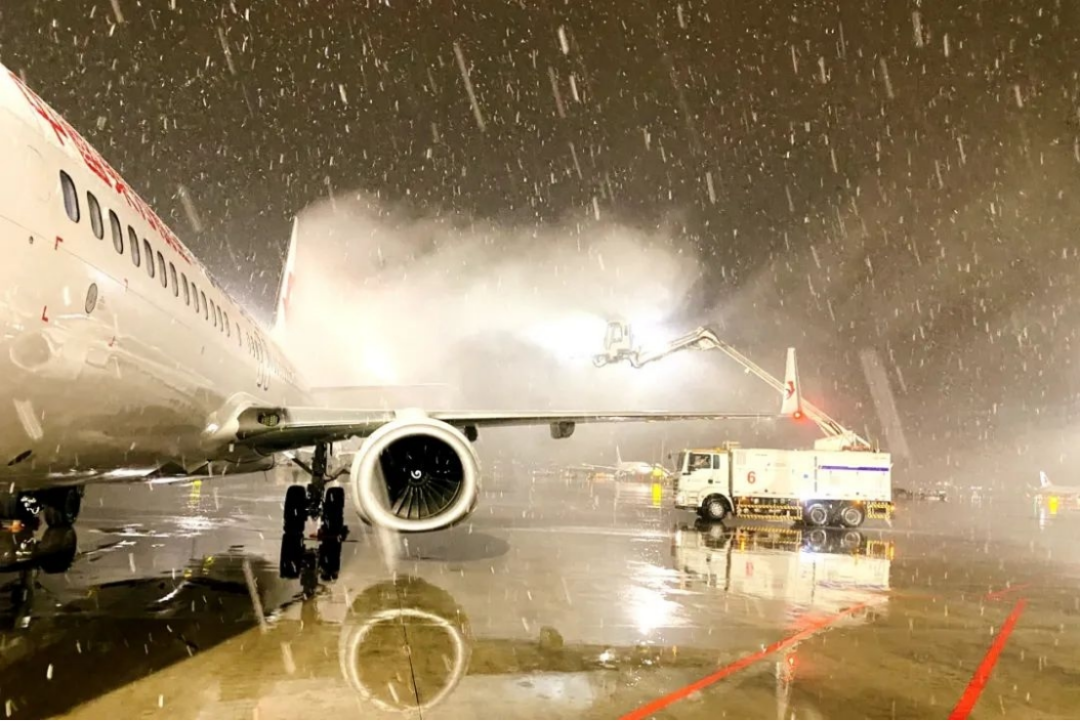
Aircraft de-icing typically uses de-icing fluid, which involves heating a de-icing fluid containing ethylene glycol or propylene glycol to 60-80 degrees Celsius and spraying it onto the aircraft surface using a specialized de-icing truck to remove ice. The de-icing fluid's freezing point decreases when mixed with water, similar to how water mixed with alcohol is less likely to freeze.
Other methods include compressed air de-icing and infrared heating de-icing.
Anti-icing involves spraying a high-viscosity anti-icing fluid after de-icing, creating a protective film on the aircraft to prevent re-icing before takeoff. This protective film cannot remain on the aircraft indefinitely; during takeoff, the anti-icing fluid must be blown off, allowing for a clean and easy takeoff.
Currently, domestic airports mainly use Type I de-icing fluid and Type IV anti-icing fluid. The former typically provides an anti-icing time of 3 minutes, while the latter provides over 80 minutes.
While anti-icing fluid can keep an aircraft from icing for a certain period, taxiing and waiting for takeoff both consume time, and insufficient anti-icing time can lead to secondary icing. In this case, "secondary de-icing" is required.
Therefore, the passenger suggestion to wait until de-icing is complete before boarding is not feasible, as this would cause the anti-icing time limit to be exceeded.
De-icing Methods Airports generally offer three de-icing services: gate de-icing, spot de-icing, and slow-moving de-icing.
Gate de-icing, as the name suggests, involves the aircraft remaining stationary at its gate while a de-icing truck moves to the gate to de-ic it. This method is suitable for airports with low de-icing frequency, such as smaller airports or some airports in southern regions, because the preparation and movement of the de-icing truck takes a considerable amount of time.
Spot de-icing involves setting up a de-icing pad near the runway takeoff position. The aircraft moves to the de-icing pad before takeoff, and the de-icing truck does not need to move. This method is more efficient for airports with high traffic.
Both of these de-icing methods require the engines to be shut down during the de-icing process.
Slow-speed de-icing is currently the most efficient de-icing method. Simply put, a de-icing zone is established on the taxiway where aircraft are queuing for takeoff. Multiple de-icing trucks and other de-icing equipment gather here. As aircraft queue on the taxiway, they pass through the de-icing zone. Multiple de-icing trucks work simultaneously, and de-icing of one aircraft can be completed in approximately 7-8 minutes. After de-icing, the aircraft can taxi directly to the runway for takeoff. Throughout the entire de-icing process, the aircraft engines are running at idle speed, hence the name "slow-speed de-icing."
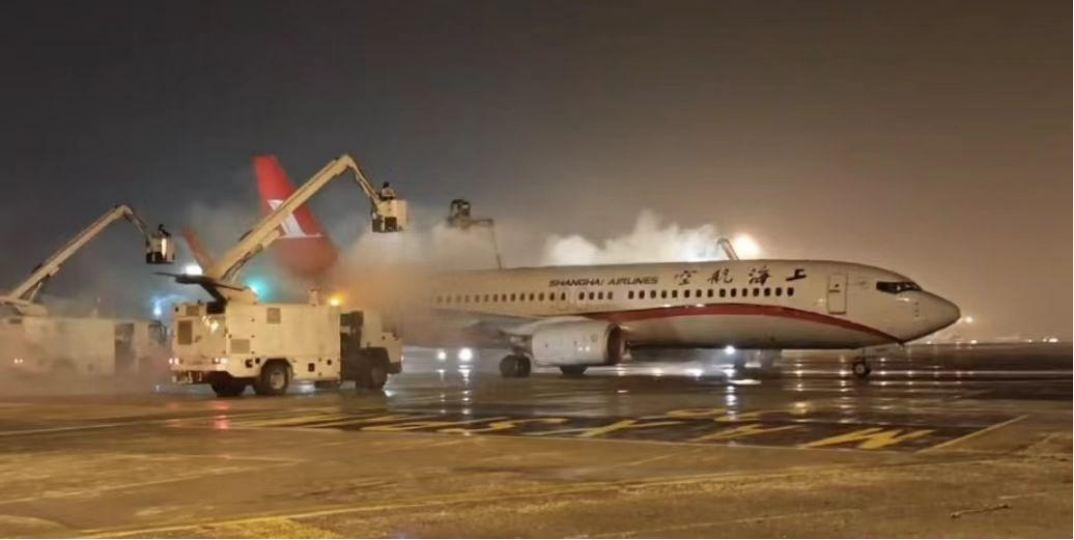
For example, Beijing Capital International Airport and Beijing Daxing International Airport often employ a "slow-speed + four-vehicle" de-icing mode. This means that without shutting down the aircraft's engines, four de-icing vehicles simultaneously de-ic the aircraft. In this mode, the four vehicles work collaboratively, each performing its specific task. With efficient and precise operation, they quickly remove ice and snow from the aircraft's surface, ensuring the aircraft returns to optimal flight condition in a short time.
Generally speaking, when an aircraft enters de-icing operation, its takeoff time is very close! Therefore, passengers are asked to be patient while waiting in line for de-icing.
Finally, let's take a closer look at how aircraft de-icing operations are performed.