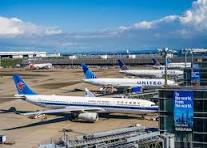
China's first "three-airport" city has arrived.
China Twin B low intensity light,
China Low intensity twin B light,
China low intensity light type A,
Customized Airport Siderow Light,
On October 20, at the North Bund International Shipping Forum, Li Nuo, Deputy Director of the Development Planning Department of the Civil Aviation Administration of China (CAAC), outlined three key milestones: By 2030, with the completion of the fourth phase of Pudong International Airport, Shanghai's annual throughput is projected to reach 150 million passengers and 4.7 million tons of cargo. By 2035, the new Nantong Airport will be completed and operational, establishing a "two-city, three-airport" system with a combined capacity of 200 million passengers and 5.4 million tons of cargo. By the middle of this century, the goal is to build a comprehensive, globally influential international aviation hub.
This "two-city, three-airport" configuration has been incorporated into official planning for the first time.
The additional airport is located on the north bank of the Yangtze River in Nantong, Jiangsu Province-officially designated as the "New Nantong Airport," though industry insiders refer to it as "Shanghai's third airport." Why would one city extend its aviation hub into the territory of another province?
The Retreat of Hongqiao, the Advance of Pudong
Shanghai did not start with two airports.
Hongqiao Airport was completed in June 1921, becoming the first newly constructed civil aviation facility in modern China. Initially, it featured only a dirt runway and could not yet handle scheduled flights; it only truly came into service in 1929, when the Shanghai–Nanjing segment of the Shanghai–Chengdu air route was launched. On April 29, 1964, following an expansion, Hongqiao became an international airport, marking the inauguration of Shanghai's first international air route. In 1972, the Air Force withdrew, and Hongqiao transitioned into an airport dedicated exclusively to civil aviation. For the next 27 years, it served as the city's sole aerial gateway.
On September 16, 1999, the first phase of Pudong International Airport opened, making Shanghai the first city in my country to possess two major international airports. Hongqiao Airport subsequently shifted its focus toward domestic express routes and business travel.
Thus, a division of labor was established: Hongqiao would cater to domestic and business travel, while Pudong would handle international and long-haul traffic. Twenty-seven years have passed, and Shanghai has grown into the world's third-busiest city for air passenger traffic.
Pudong Airport reached the top spot nationwide in 26 years-but it has also hit a ceiling.
The origins of Pudong Airport lie in a national-level strategic decision. Following the launch of the Pudong development and opening-up initiative in 1990, construction of the airport began; the first phase opened for operations in 1999. Terminal 2 and a second runway were commissioned in 2008, a fourth runway was completed in 2015, and the fourth phase of expansion broke ground in January 2022. Terminal 3 is designed with a capacity of 50 million passengers; once completed at the end of 2028, Pudong Airport's total annual capacity will reach 130 million passengers.
The 2025 performance figures: Pudong Airport handled 84.9945 million passengers-ranking first in China-and 4.0919 million tonnes of cargo and mail, the first time the latter has surpassed the 4 million-tonne mark. Hongqiao Airport handled 50.151 million passengers, joining the global "50-million-passenger club" for the first time. Together, the two airports handled 135 million passengers and 4.5 million tonnes of cargo, with 839,000 aircraft takeoffs and landings-all three metrics hitting historic highs.
Yet, a "historic high" can often be two sides of the same coin as an "upper limit." With four runways, two terminals, and a satellite concourse, Pudong Airport is nearing full capacity; meanwhile, Hongqiao Airport is hemmed in by the city, leaving no room for expansion. The 135 million passengers served by the two airports in 2025 already exceed their designed capacity of 120 million-a target originally set for the end of the 13th Five-Year Plan period.
A 65-million-passenger gap.
Now, let's look at the math.
According to current plans, Shanghai's aviation hub is set to reach a capacity of 200 million passengers by 2035. Bridging the gap from 135 million to 200 million means accommodating an additional 65 million passengers over the next decade-the equivalent of building another Hongqiao Airport, plus a little bit more. How can this additional capacity be absorbed? While the fourth phase of Pudong Airport is expected to suffice until 2030, Hongqiao Airport has no room for expansion. Regarding airspace, the Shanghai approach control area already operates on a "five-in, five-out" structure; further increasing flight density would lead to a sharp rise in marginal costs. At the forum, the Civil Aviation Administration of China (CAAC) clearly outlined the challenges: tightening constraints on airspace resources, a need to strengthen competitiveness in international transit, and the fact that coordination within the hub system is still in its nascent stages.
There are only two ways forward: find new capacity beyond the existing two airports, or divert passenger traffic elsewhere. Shanghai has chosen the former.
Among the five candidates, why Nantong?
In early 2019, the potential site for a third Shanghai airport became a hot topic of public discussion. Nantong emerged as a primary focus, "outshining" other competing cities-though the reports were officially denied at the time. The list of candidates then under consideration included Nantong, Suzhou, Shanghai's Chongming and Fengxian districts, and Jiaxing in Zhejiang Province.
The selection process among these five candidates was not based on the size of their respective economies.
Suzhou drew the most attention. It boasts the highest GDP of any prefecture-level city in China and is the only city with a population exceeding 5 million that lacks an airport. However, this unique status is complicated by two major constraints.
The first is airspace. In a public statement, the Jiangsu Provincial Development and Reform Commission explained that, given the high density of military and civil airports in the area surrounding Suzhou, airspace resources are extremely strained, and conflicts between military and civil aviation operations are significant. Consequently, building an airport in Suzhou presents major challenges and remains in the stage of research and feasibility assessment.
The second constraint is proximity. A high-speed train ride from northern Suzhou to Hongqiao Airport takes just over 20 minutes, and the Suzhou Metro is already connected to the Shanghai rail transit network. Because Suzhou lies firmly within the primary catchment area of Shanghai's existing two airports, constructing another large-scale (4F-class) airport would essentially serve a population that is already being catered to.
The issues facing Jiaxing, Chongming, and Fengxian are even more straightforward. Jiaxing is located roughly 100 kilometers from Hongqiao, Pudong, and Xiaoshan airports-an area with one of the highest concentrations of airports in the Yangtze River Delta-and it already possesses an operational airfield. Chongming is designated as an "ecological island" and falls directly within the flight paths used for arrivals and departures at Pudong Airport. Fengxian is less than 50 kilometers from Pudong in a straight line; building an airport there would effectively just amount to adding a second runway for Pudong. In short, searching for a site within Shanghai's own airspace is a futile exercise.
Planning for the New Nantong Airport
In 2020, the Shanghai Airport Authority and the Nantong Municipal Government signed an agreement to jointly develop a new airport in Nantong. The site selection for the project was officially approved that same year.
In August 2025, the Shanghai-Jiangsu Nantong New Airport Construction Investment Co., Ltd. was established, with the Shanghai Airport Authority holding a 51% stake and the Nantong Urban Construction Group holding 49%.
The airport is sited in Erjia Town, Tongzhou District, Nantong-approximately 100 kilometers in a straight line from both Shanghai Hongqiao and Pudong airports. According to the master plan, the first phase will feature two parallel runways (the western runway rated 4E, the eastern runway rated 4F), each 3,600 meters long and spaced 2,250 meters apart. The initial terminal building will span 520,000 square meters, with 80 contact stands (gates with jet bridges) and 38 remote stands. The near-term design target for 2035 anticipates an annual passenger throughput of 40 million and a cargo/mail throughput of 500,000 tons, with long-term plans allowing for a capacity of up to 80 million passengers per year.
Construction of the new Nantong airport is set to begin in 2027, with operations scheduled to commence in 2035.
How will the "two cities, three airports" system function?
The division of roles has already been defined in the master plan. According to Li Nuo, the Shanghai international aviation hub is set to evolve from its current two-airport configuration (Pudong and Hongqiao) into a "two-city, three-airport" system-comprising Pudong, Hongqiao, and a new airport in Nantong. This shift will entail a large-scale restructuring of the hub's functional, operational, and governance systems. Such a governance model, characterized by differentiated yet coordinated development across multiple airports, is a first in the history of Chinese civil aviation.
Pudong Airport is designated as the primary platform for the Shanghai international aviation hub. It will focus on strengthening its role as a comprehensive, multi-functional gateway-handling both passengers and cargo-while building a high-quality, efficient global route network. It will also enhance its capacity for intercontinental transit, connecting to five major strategic corridors, with the goal of becoming the premier intercontinental regional gateway in Northeast Asia.
Hongqiao Airport serves as a vital pillar of the Shanghai international aviation hub. Its primary focus is to enhance domestic "express" services and overall convenience, setting a benchmark for high-quality aviation services. It will maintain seamless connectivity and coordinated development with Pudong Airport, while also expanding its international air transport capabilities as appropriate.
The new airport in Nantong is an essential component of the Shanghai international aviation hub. It will primarily take on the non-core functions currently handled by Pudong and Hongqiao airports. Focusing on both passengers and cargo-with an emphasis on domestic traffic-it will develop a highly accessible route network that serves as a vital link to regional feeder routes.
From a simple dirt runway at Hongqiao in 1921 to a three-airport network spanning both sides of the Yangtze River by 2035, Shanghai has journeyed for 114 years. While the new airport is being built in Nantong, the true answer to its purpose lies within the Yangtze River Delta region as a whole.